|
||
|
A European Agreement group covering the certification of products, materials, systems and services in the fields of fire protection, security and loss prevention
|
||
|
|
|
Aims and tasks
Within the harmonisation of the European market EFSG is in train to establish a common approach to product conformity certification and the technical equivalence of certification. This is to ensure that all member bodies including their associated laboratories are operating on a common basis. Furthermore this is to respond to the danger that European standards and specifications are weakened. For the client - the manufacturer of equipment, components and systems used in fire protection and security technology - the effects of this work are represented in a reduction of costs for testing, at the same time he can obtain certification from more than one certification body and their related marks without unnecessary duplication of testing, assessment and assessment of laboratories. For these aims the trust in the competence is of major importance and impartial fundaments have to be base for the co-operation of members of EFSG. The new approach of EFSG has been presented to EFSAC during the General Assembly meeting on 5th December 2000. EFSG is concentrating on the so-called procedure "Multiple Certification" as the original aim to introduce a European certification brand was not possible. EFSG has been admitted as associated member to the European Fire and Security Advisory Council (EFSAC) which is an institution of European manufacturers associations. |
|
Certification of products
Certification of services
|
|
Members
EFSG is a group of at the moment eight certification bodies comprising 1. Centre National de Prévention et de Protection (CNPP) formerly APSAD 2. Building Research Establishment (BRE) formerly LPCB 4. Svensk Brand & Säkerhets Certifiering AB (SBSC) 5. AFAQ AFNOR Certification (AFNOR) |
|
One-stop-testing and multiple certification in the field of intruder alarm systems by EFSG The new Basic Agreement on components of intruder alarm systems (IAS) has been signed on 26th November 2008 by five certification bodies being member of EFSG Cologne, December 2008. The European Fire and Security Group extends its offer for manufacturers in the field of intruder alarm systems with a Basic Agreement signed by France, Germany and Great Britain. This represents a further step towards a European testing and certification scheme besides the agreements on components of fire alarm systems, high security locks and safes & strongrooms. Basic and multilateral agreements issued by EFSG intend to offer manufacturers the possibility to gain with a one-stop-testing multiple certification Europe-wide. Manufacturers may choose an associated testing laboratory and a certification body that have signed one of the mentioned agreements and apply here for testing and certification. With this issue a product is tested once and may be certified for several brands. The Basic Agreement on components of intruder alarm systems is as first issue elaborated for the following products: EN 50131-2-2:2008 “Alarm Systems – Intrusion and hold-up systems – Part 2-2: Requirements for passive infrared detectors Signatories of the agreement are as certification bodies: AFNOR Certification, CNPP, VdS, BRE Global and as associated testing laboratories: CNPP, VdS, BRE Global. The scope of this agreement in first issue is limited to the mutual acceptance of the environmental and electromagnetic compatibility (EMC) tests associated with motion detectors. An extension of the agreement for the following products is planned already for 2009: Agreements between members of EFSG For your information these agreements may be downloaded. Please klick on the respective agreement to receive a pdf-file.
For details on these agreements please contact the EFSG secretariat. Manufacturers of security products (safes and strongrooms, high security locks or fire detection and fire alarm components, components of intruder alarm systems) have the possibility to apply for product approval at several certification bodies based on single testing. Generally an individual application must be directed to each desired certification body of the relevant agreement group. The procedure for such multiple certification is as follows:
|
|
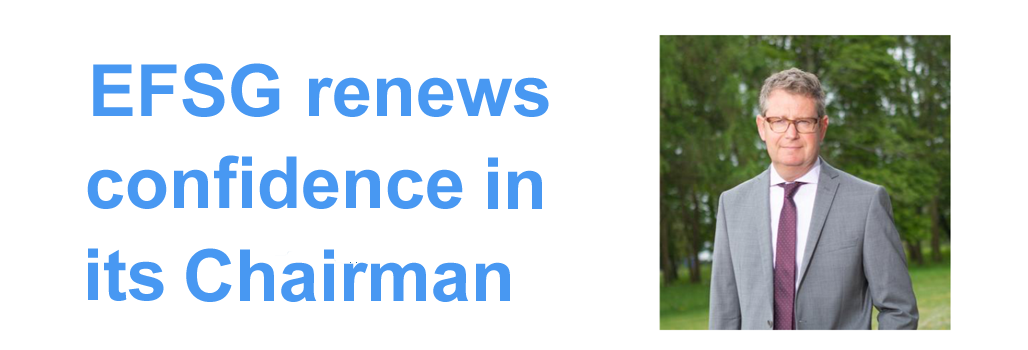
President of EFSG is Mr Benoît Clair, Centre National de Prévention et de Protection, Vernon. EFSG Secretariat |